
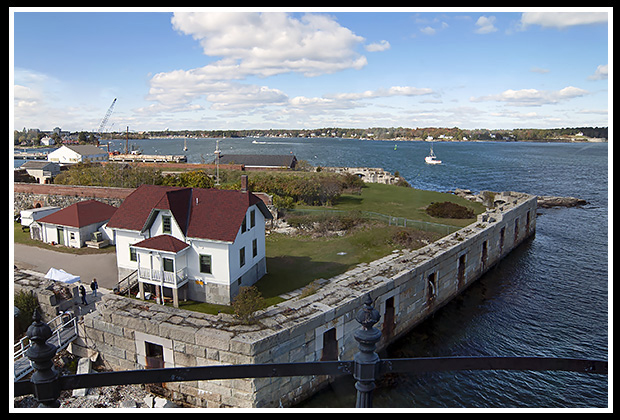
View of Fort Constitution (initially Fort William and Mary) from the current Portsmouth Harbor Light tower. The original lighthouse was built inside the fort.
Stolen Munitions by Portsmouth Harbor Light Helped Colonists in the First Battles of the American Revolutionary War
The American Revolution, also known as the Revolutionary War, began with the Battle of Lexington, where the first shots were fired. Known as the “shot heard ‘round the world,” it ignited a brief exchange of gunfire between British troops and the colonial militia. The British then moved on to Concord, where they were forced to retreat on April 19, 1775. The next major battle was the Battle of Bunker Hill on June 17, 1775, in Massachusetts, where the colonial militia endured the heaviest losses.
The militia members were known as “minutemen” because they could be ready at a moment’s notice. Those involved in fighting against the British but not in the military were usually called patriots, like Thomas Jefferson and Ben Franklin. Those loyal to the Crown were called Loyalists or Tories. What many don’t realize is that the munitions used in these early battles and others were taken from a British-occupied fort, by its lighthouse, in Portsmouth, New Hampshire.
By the early 1770s, Boston Light had been effectively guiding thousands of ships into Boston Harbor. The prosperity from the trade volume through Boston Harbor increased the wealth of many in England, who greatly benefited from colonial small businesses through taxation. The penny-per-pound tax on tea became the tipping point for many colonial merchants, who had had enough. On December 16, 1773, about 60 members of the Sons of Liberty, led by Patriot Samuel Adams, disguised themselves as Mohawk Indians. They boarded ships from the East India Company and threw 342 chests of tea into the harbor, an event known as the “Boston Tea Party.” The event sparked controversy, even among the unhappy colonists who believed the event was more of a mob rule.
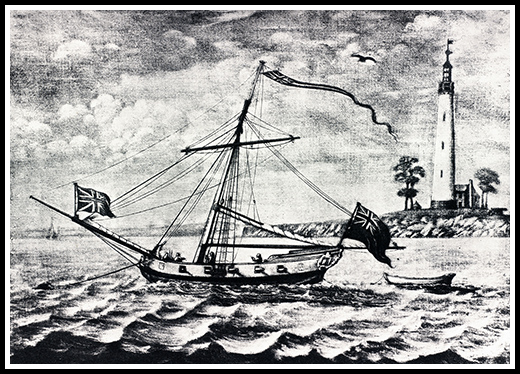
1729 Etching of Boston Light by William Burgis. Courtesy Boston Public Library
In a strategic move in 1774, the British seized Little Brewster Island and Boston Light. By early 1775, they had effectively blockaded Boston Harbor, preventing any ships from reaching the colonists, who continued to resist with numerous skirmishes against British tyranny. Boston Light was transferred from civilian ownership, initially managed by the Massachusetts Provincial Council and funded through taxes on British and foreign ships, to a military station occupied by the British. Both sides understood the lighthouse’s strategic importance to their opponent, as the beacon remained unlit so that neither side could use it for navigation.
A little farther north of Boston, the well-protected harbor of Portsmouth, New Hampshire, located on the Piscataqua River, was also a significant port during the colonial era, helping many in England become wealthy. Fort William and Mary was first built by the British nearly 500 years ago in 1631 and was initially called “The Castle,” until 1692, when it was named after the accession of both the King and Queen of England. It is one of the oldest forts in the country. The fort sits on Great Island, now called New Castle Island, just outside Portsmouth. It was easy to reach by road, even during low tide. The fort served as a trading port, a target of warfare, and a military training site.
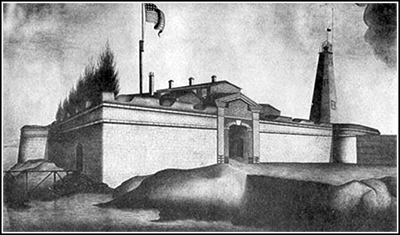
Illustration of Fort William and Mary, author unknown.
Portsmouth Harbor Lighthouse, built as a wooden tower topped with an iron lantern and a copper roof in 1771, sat within the British-occupied Fort William and Mary. Both the lighthouse and the fort became significant military targets before and during the American Revolution. The lighthouse was the first light station established at a British military installation in the colonies north of Boston.
The Boston Tea Party and earlier events enraged King George, who issued an order prohibiting the export of gunpowder and military arms to the disloyal colonists. These colonists used munitions mainly for hunting, but also for security. British troops were ordered to secure all stored munitions in New England. The powder and guns at Fort William and Mary in New Castle were especially vulnerable, as the old fort was in poor condition and guarded by only six men.
In early December 1774, when the British started their blockade of Boston Harbor against the colonists, they took control of Boston Light. They aimed to bolster their other military positions in preparation for a major revolt. Hearing this news, exactly one year after the Boston Tea Party, Paul Revere rode from Boston to Portsmouth through a blinding snowstorm to warn the community about the British planning to reinforce Fort William and Mary, as only a small number of soldiers were guarding the fort. At the time, Revere was a member of a secret group called the Mechanics. Many of the local citizens of Portsmouth and the surrounding area were just as frustrated and angry with the British as those in Boston.
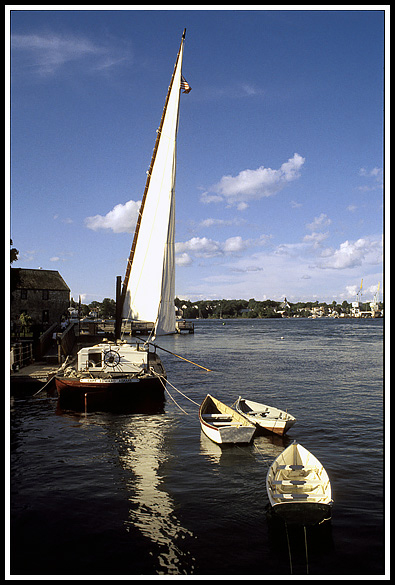
Gundalow barge with sail in Portsmouth Harbor.
On December 14, 1774, many local citizens organized in groups by grabbing small boats or climbing onto small barges called “gundalows” and riding the outgoing tide down the Piscataqua River toward the fort. Others hiked along the shoreline. The fort’s British Captain, John Cochran, ordered his small troop to aim the cannons for an attack and threatened to shoot any of his men who tried to run. As the angry mob outside the fort grew into the hundreds, Cochran allowed one of the leaders, John Langdon, a seafarer turned shipowner and merchant, and an acquaintance, inside the gates for a brief discussion. Langdon told the captain the mob was going to take all the munitions in the fort, but Cochran stood firm and warned Langdon that the crowd would be fired upon, and blood would be shed.
Langdon and his partner were taken outside the gates, and the angry captain readied his men to load three cannons. The nervous guards hurriedly fired the cannons, but no one was hit, probably as a warning. Muskets were shot in front of the angry mob as a warning, but as the soldiers tried to reload, the raiders climbed over the crumbled walls of the fort from all sides. Fearing for their lives, Cochan and his men tried to defend themselves but were quickly disarmed, and one raider was wounded in the arm by a bayonet. Luckily, there were no deaths on either side. With the British soldiers disarmed, they watched in disgust as the rebels cheered on while the British flag was taken down.
The rebels tried to make the captain hand over the keys to the powder house, where many 100-pound barrels were stored. When the captain refused to hand over the keys, they dragged him to his home inside the fort walls, where his wife, Sarah, briefly tried to stop her captors with a bayonet before she was subdued. The men broke into the armory with axes and crowbars and finally reached the gunpowder. Most of the barrels were loaded onto gundalows and sailed down the seacoast, while others were carried away. One barrel was left in the powder house. They were carefully hidden in different towns—inside homes, taverns, barns, and churches along the seacoast.
The next day, on December 15, about a hundred determined locals returned to steal muskets and other munitions and disable the cannons. They loaded 16 small cannons, 10 cannon carriages, and 42 muskets onto gundalows, a process that took hours, leaving the larger cannons behind. Unfortunately, the river tide was coming in, and they had to anxiously wait a few hours for the tide to go out before safely escaping. As luck would have it, they made it out just before two British warships appeared the next day. The soldiers and their captain were released unharmed when the rebels left the fort. What makes the raid on Fort William and Mary unique is that it was the first fully organized, large-scale, “armed attack” by colonists against the authority of the King himself.
The weapons stolen from Fort William and Mary were used in the first battles of Lexington and Concord, at Bunker Hill in Boston, and in other local fights. This act became one of the initial steps of the American Revolution against the British. When the war started, Portsmouth Harbor Light remained unlit from 1774 to 1784, as it was either held by British forces or colonists to prevent the enemy from using it for navigation. Local colonial forces first took control of the beacon, then the British retook it, and afterward, it was abandoned but not destroyed by them. It still served as a lookout in Portsmouth’s defenses during the Revolution. After the Revolutionary War ended on September 3, 1783, the fort was renamed Fort Constitution, and Portsmouth Harbor Light was transferred to the new American government. Today, Portsmouth Harbor Light is also known as Fort Point Light, New Castle Light, and Fort Constitution Light.
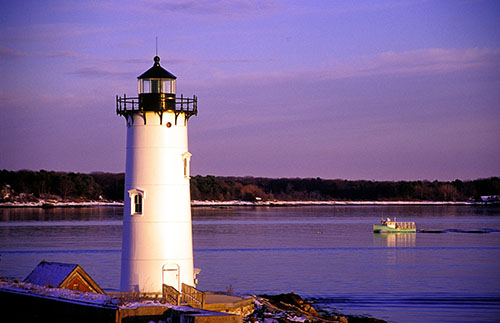
Portsmouth Harbor Lighthouse at Dusk
On a side note, regarding Boston Light: The British were eventually forced out of Boston by the Continental Army and local militia in 1776. On June 13, 1776, they left Boston and destroyed the tower of Boston Light. Like Portsmouth Harbor Light, the lighthouse remained dark during the war. After the Revolutionary War ended, Boston Light’s tower was rebuilt in late 1783. Despite facing a series of destructive fires and storms over the centuries, the tower built in 1783 still stands today.
Books to Explore
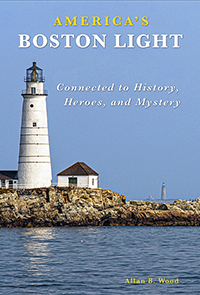
America’s Boston Light:
Connected to History, Heroes, and Mystery
Celebrating 310 years, explore Boston Light’s history and its ties to historical events, shipwrecks, and rescues by its keepers and local lifesavers. Learn about its connections to famous heroes, notable figures like Ben Franklin, and intriguing mysteries.
Rich in colorful paintings, photos, and vintage images, these visuals bring the stories to life. Embark on this captivating journey through maritime history!
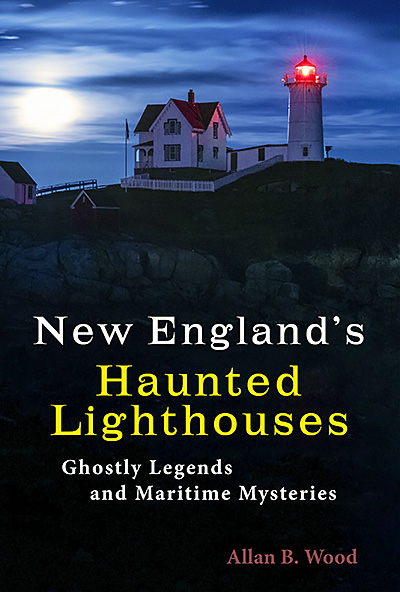
New England’s Haunted Lighthouses
New England’s Haunted Lighthouses:
Ghostly Legends and Maritime Mysteries
Uncover the mysteries of New England’s haunted lighthouses! Uncover ghostly tales of lingering keepers, victims of misfortune or local shipwrecks, lost souls, ghost ships, and more. Many of these accounts begin with actual historical events that later give rise to unexplained incidents. Immerse yourself in the tales associated with these iconic beacons!
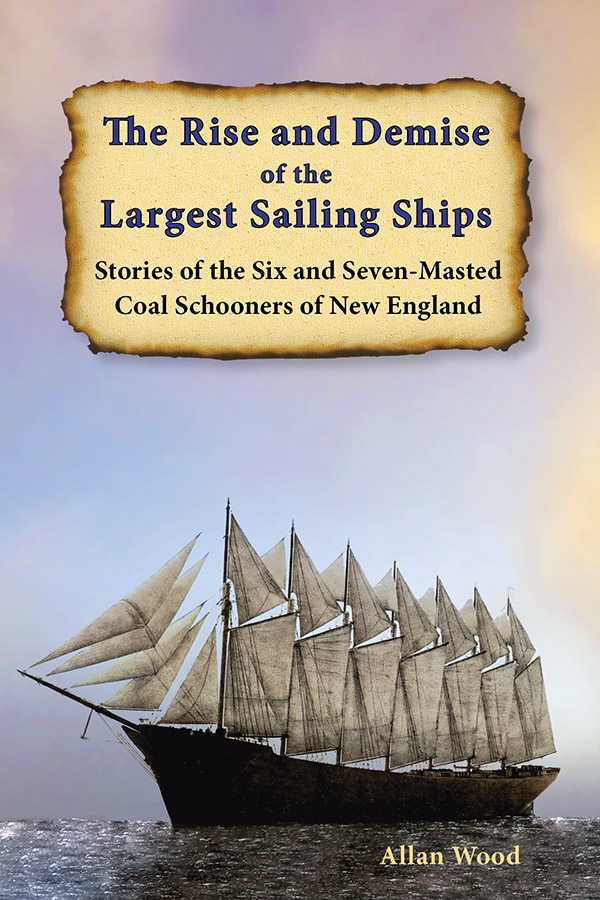
The Rise and Demise of the Largest Sailing Ships
The Rise and Demise of the Largest Sailing Ships:
Stories of the Six and Seven-Masted Coal Schooners of New England
In the early 1900s, New England shipbuilders constructed the world’s largest sailing ships amid social and political reforms. These giants were the ten original six-masted coal schooners and one colossal seven-masted vessel, built to carry massive quantities of coal and building supplies, and measured longer than a football field! This self-published book, rich in color and vintage images, showcases the historical accounts that accompanied these mighty ships.
Available also from bookstores in paperback, hardcover, and as an eBook for all devices.

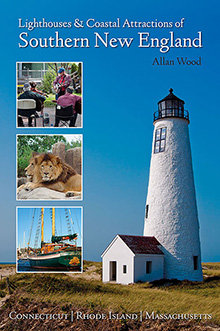
Book – Lighthouses and Coastal Attractions in Southern New England: Connecticut, Rhode Island, Massachusetts
Lighthouses and Coastal Attractions of Southern New England:
Connecticut, Rhode Island, and Massachusetts.
This 300-page book provides memorable human interest stories from each of the 92 lighthouses. You can explore plenty of indoor and outdoor coastal attractions, including whale-watching excursions, lighthouse tours, windjammer sailing tours, parks, museums, and even lighthouses where you can stay overnight. You’ll also find plenty of stories of hauntings around lighthouses.

Book – Lighthouses and Coastal Attractions in Northern New England: New Hampshire, Maine, Vermont
Lighthouses and Coastal Attractions of Northern New England:
New Hampshire, Maine, and Vermont.
This 300-page book provides memorable human interest stories from each of the 76 lighthouses. It also describes and provides contact information for numerous indoor and outdoor coastal attractions and tours. These include whale watching, lighthouse tours, unique parks, museums, and lighthouses where you can stay overnight. There are also stories of haunted lighthouses in these regions.
Copyright © Allan Wood Photography; do not reproduce without permission. All rights reserved.

American Lighthouse Foundation
Join, Learn, and Support The American Lighthouse Foundation