
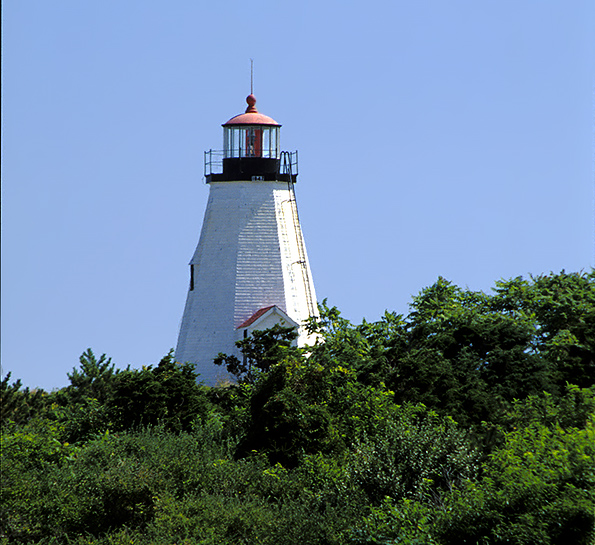
Plymouth (Gurnet) Lighthouse in Massachusetts
First Female Keeper, Hannah Thomas, of Plymouth (Gurnet) Light in Massachusetts
Hannah Thomas was born around 1731 in Middleboro, on Gurnet Point in Plymouth. Her parents owned a dairy farm that spanned a long sandy strip of peninsula located at the northern corner of Plymouth Bay, a few miles from Plymouth Rock. She was 16 when her father died, and she received one-third of the farm’s land. In 1761, she married Dr. John Thomas, a surgeon who later became Col. Thomas of Kingston, and they took over the operation of the farm.
In the mid-1760s, the Colonial government asked John and Hannah Thomas to have a lighthouse constructed on their land. The government agreed to rent the land for 5 shillings a year. An act of the colonial legislature on February 17, 1768, authorized the first lighthouse on the high bluff at the eastern end of the Gurnet.
John Thomas was appointed as the first Keeper, a customary position in the early days of lighthouse history. This role allowed John to become one of America’s first light keepers in 1769 at Gurnet Point Light in Plymouth, Massachusetts. Shortly thereafter, he was called to fight in the Revolutionary War, leaving his wife Hannah to assume all responsibilities at the lighthouse. In tending to the lighthouse alone, Hannah became America’s first woman lighthouse keeper. John Thomas rose to the rank of major general, leading troops at Quebec. He never returned from the war; smallpox spread through his troops, and Thomas succumbed to the disease on June 2, 1776, in the Chambly Monteregie Region of the Province of Quebec, south of Montreal, Canada.
A widowed mother of three young children, dairy farmer, and lighthouse keeper, Hannah Thomas fought for her rights as the legitimate owner of the lighthouse on the Gurnet. She was also a successful business owner who challenged the government of Massachusetts when it attempted to revoke her rights as keeper of the lighthouse on her property. In 1776, after Fort Andrew was erected at Gurnet Point, and during the Revolution, the British frigate H.M.S. Niger reportedly sailed around the Gurnet toward Plymouth Harbor, exchanging fire with the fort’s six-cannon battery. Many believe that one of the cannonballs struck the lighthouse in the process. Hannah also challenged the government for compensation when the cannonball from Fort Andrew damaged her property.
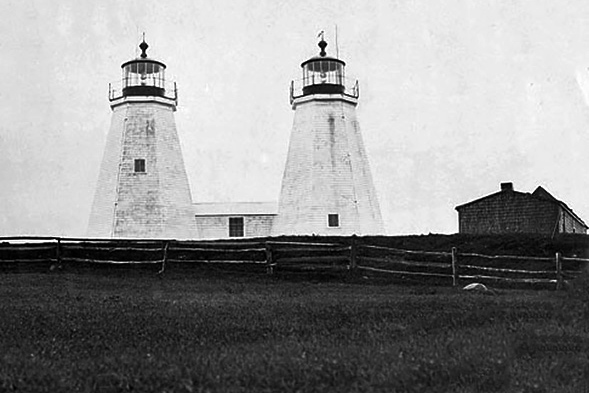
Two Towers of Plymouth (Gurnet ) Lighthouse was built in 1842 in Massachusetts. Image courtesy US Coast Guard.
Plymouth’s worst shipwreck occurred in 1778, when the American privateer General Arnold was trapped in a blizzard less than a mile from Gurnet (Plymouth) Light. Choosing to forego the risk of entering Plymouth’s inner harbor without a pilot, the captain dropped anchor, hoping to ride out the storm. As the gale rose to hurricane force, the vessel had its anchor dislodged and ran aground on White Flats. Before the residents of Gurnet could construct a causeway over the ice to reach the stranded vessel, 72 of its crew of just over 100 froze to death in view of the lighthouse.
Hannah faithfully served at the lighthouse and helped to hire a local resident, Nathaniel Burgess, to act as keeper in 1786. During that same year, a coasting sloop traveling from Boston to Plymouth struck a sandbar near the Gurnet. Two of the seamen from the vessel trudged 7 miles through a bitter snowstorm to reach Gurnet Lighthouse to try to get help. Keeper Burgess fed and warmed them by the fire before dispatching his assistant, Hannah’s son John, to bring in the rest of the crew.
After the American Revolution, the lighthouse was refurbished and put back into service in 1790. The light was ceded to the U.S. government, and Hannah Thomas’s son, John Thomas, took over as keeper. He had worked with his mother at the station for many years by the time he received the official appointment. His salary of $200 per annum was lower than at other lighthouses, because the Gurnet was deemed an acceptable place to live with ample fishing & land with good soil to garden. John Thomas remained faithfully as Keeper until 1812. He was replaced by Nathaniel Burgess’ son, Joseph Burgess, who remained as keeper for 39 years.
After the lighthouse was completely destroyed in a fire on July 2, 1801, the merchants of Plymouth and Duxbury funded the construction of a temporary beacon. On April 6, 1802, Congress voted to repay them $270 and appropriated $2,500 to rebuild the lighthouse on the Gurnet. The Thomas family received $120 for the land on which twin lighthouses, each 22 feet tall and spaced 30 feet apart, were built in 1803.
Hannah died at the age of 88 on April 1, 1819.
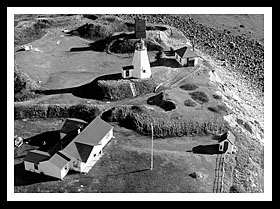
Aerial View of Plymouth (Gurnet) Light in Massachusetts
Image Courtesy US Coast Guard
In 1842, the crumbling towers were replaced by two white octagonal pyramidal towers. However, the lights were too close together and often appeared as a merged single beam of light.
In 1924, the Bureau of Lighthouses discontinued one of the twin lights as it phased out several lights. The remaining light still stands.
On April 13, 2019, Project Gurnet and Bug Lights Inc. honored Hannah Thomas as America’s first female lighthouse keeper by organizing a ceremony and placing a U.S. Lighthouse Service Marker at her gravesite in the Old Burying Ground in Kingston.
The Spirit of Hannah Thomas Occasionally Visits Keepers
It is believed that Hannah still haunts the house; some previous keepers have witnessed a sad woman dressed in colonial attire walking about the house or tower. Some years ago, a husband and wife- both photographers- spent the night at Gurnet Point Light as guests in the keeper’s house. The husband reported that during the middle of the night, he awoke to see the ghost of a sad-faced woman hovering above his wife, who was fast asleep. The woman, dressed in colonial clothing, appeared to be in her thirties with long dark hair.
As he watched her, he felt no threat from her, only her sadness. He could see the rays of light from the lighthouse flashing around several times, brightening the room. He looked away briefly toward the light, and when he looked back to where she had been, she was gone.
Staying Overnight at Plymouth (Gurnet) Lighthouse
The lighthouse is owned by the Project Gurnet and Bug Lights organization, and visitors are not allowed to drive to it as it is private property. During the summer months, the organization will provide overnight accommodations in the renovated keeper’s building, which can sleep up to 14 visitors in its four bedrooms, including two bunk rooms and two baths.
Books to Explore
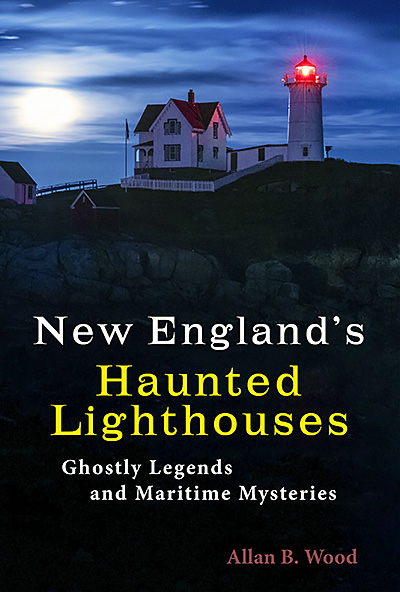
New England’s Haunted Lighthouses
New England’s Haunted Lighthouses:
Ghostly Legends and Maritime Mysteries
Uncover the mysteries of New England’s haunted lighthouses! Uncover ghostly tales of lingering keepers, victims of misfortune or local shipwrecks, lost souls, ghost ships, and more. Many of these accounts begin with actual historical events that later give rise to unexplained incidents. Immerse yourself in the tales associated with these iconic beacons!
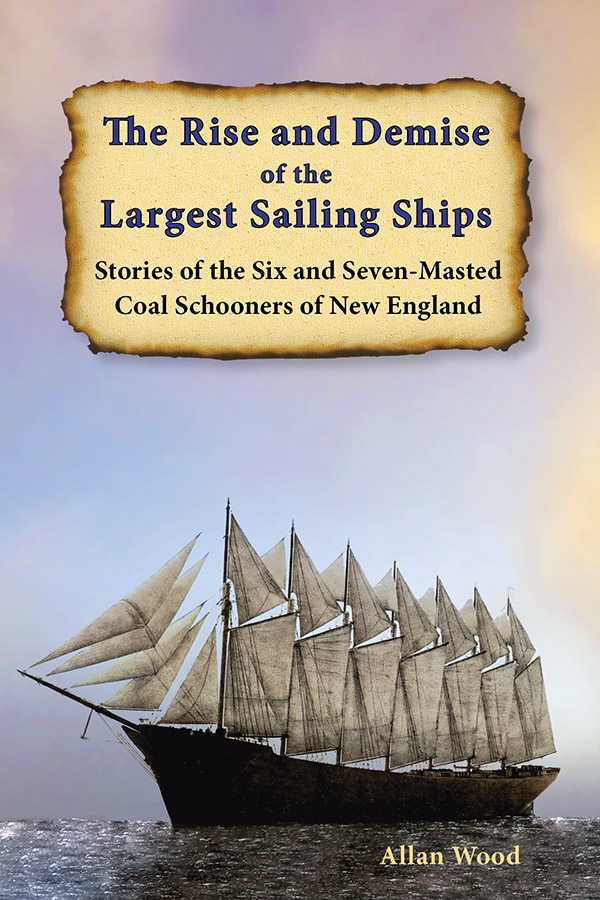
The Rise and Demise of the Largest Sailing Ships
The Rise and Demise of the Largest Sailing Ships:
Stories of the Six and Seven-Masted Coal Schooners of New England
In the early 1900s, New England shipbuilders constructed the world’s largest sailing ships amid social and political reforms. These giants were the ten original six-masted coal schooners and one colossal seven-masted vessel, built to carry massive quantities of coal and building supplies, and measured longer than a football field! This self-published book, rich in color and vintage images, showcases the historical accounts that accompanied these mighty ships.
Available also from bookstores in paperback, hardcover, and as an eBook for all devices.

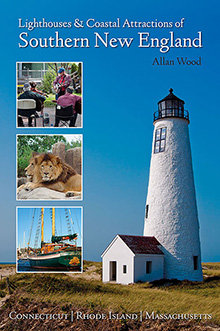
Book – Lighthouses and Coastal Attractions in Southern New England: Connecticut, Rhode Island, Massachusetts
Lighthouses and Coastal Attractions of Southern New England:
Connecticut, Rhode Island, and Massachusetts.
This 300-page book provides memorable human interest stories from each of the 92 lighthouses. You can explore plenty of indoor and outdoor coastal attractions, including whale-watching excursions, lighthouse tours, windjammer sailing tours, parks, museums, and even lighthouses where you can stay overnight. You’ll also find plenty of stories of hauntings around lighthouses.

Book – Lighthouses and Coastal Attractions in Northern New England: New Hampshire, Maine, Vermont
Lighthouses and Coastal Attractions of Northern New England:
New Hampshire, Maine, and Vermont.
This 300-page book provides memorable human interest stories from each of the 76 lighthouses. It also describes and provides contact info for plenty of indoor and outdoor coastal attractions and tours. These include whale watching, lighthouse tours, unique parks, museums, and lighthouses where you can stay overnight. There are also stories of haunted lighthouses in these regions.
Copyright © Allan Wood Photography; do not reproduce without permission. All rights reserved.

American Lighthouse Foundation
Join, Learn, and Support The American Lighthouse Foundation