
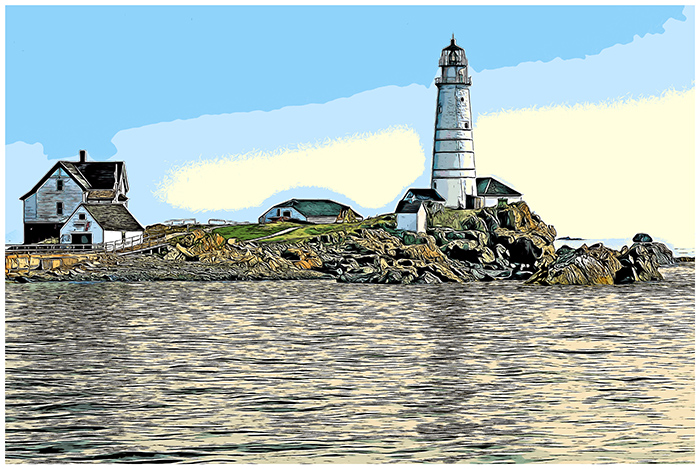
Digital illustration of Boston Harbor Lighthouse tower in Massachusetts..
A Little Bit of History of Boston Harbor Lighthouse, The Oldest Lighthouse Station in the Nation
Boston was a major shipping port for the British and their colonies in the early seventeenth and eighteenth centuries. However, the harbor has numerous rocky islands, shoals, and ledges where many shipwrecks occurred due to New England’s ever-changing stormy weather. In 1716, the Colony of Massachusetts Bay constructed and illuminated the first lighthouse in the “New World” overlooking Boston Harbor. At that time, there were only 70 lighthouses in existence worldwide. The beacon’s first light featured a two-tiered chandelier with seven candles on each tier. The Boston Harbor lighthouse became the first lighthouse station in the country, built on Little Brewster Island in Boston Harbor. The tower is technically the second oldest, as it had to be rebuilt in 1783.
Nearly two years after his appointment as the first keeper of Boston Light, on a cold November day in 1718, George Worthylake headed back to the lighthouse on a sloop from Boston after collecting his pay and gathering supplies with his wife, Anne; his daughter, Ruth; his servant, George Cutler; and a friend, John Edge. His other daughter, Ann, and a friend, Mary Thompson, watched from the shore. The seas were choppy from the gusts of wind kicking up from an approaching storm. The sloop was anchored at a distance from the lighthouse as a small lapstrake boarding boat was sent out to bring the five passengers back to the lighthouse. As the wind picked up, it forced the little boat to capsize under the weight of the six passengers, spilling them into the freezing waters and drowning them all.
The second keeper, Robert Saunders, who was appointed as the interim keeper while an appointed keeper awaited confirmation, drowned just two weeks into the new position after the tragedy of the Worthylakes.
After hearing about the two tragedies, 12-year-old Benjamin Franklin was encouraged by his brother to use his locally known writing skills to create a poem about the disaster. Franklin wrote a poem titled “The Lighthouse Tragedy” and made copies to sell on the streets of Boston.
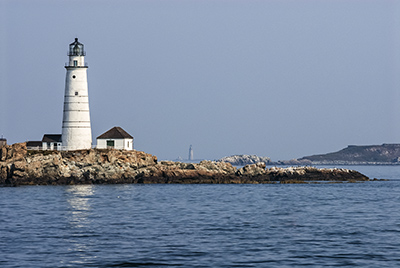
Early morning by Boston Harbor Lighthouse.
The third keeper, John Hayes, requested that “a great gun be placed on Said Island to answer ships in a fog.” His request was granted, but the responsibilities related to maintaining the cannon were added to his duties without a pay increase. In 1720, Hayes attempted to extinguish a fire in the tower after a candle spilled onto a wooden bench. The Council did not provide his pay until he could prove that the fire was not set intentionally. Eventually, he persuaded the committee of his innocence and was given back his pay.
In 1719, the nation’s first fog signal, a cannon, was created and used on Little Brewster Island until being eventually replaced by a 1,375-pound fog bell operated by clockwork machinery in 1851. The original cannon is currently displayed at Connecticut’s U.S. Coast Guard Academy.
In the mid-1700s, when lightning struck the tower multiple times, a lightning rod, invented by Ben Franklin, was initially approved for installation; however, it was initially hampered by local religious individuals who were reluctant to interfere with acts of God. A lightning conductor was eventually installed on the tower many years later, in the 1770s.
Boston Light During the American Revolution
The lighthouse was the scene of several important battles during the Revolution, as the British occupied it as a strategic post. First, the Colonial Minutemen set fire to the lighthouse in July 1775 to strike back at the British blockade, which was started after the “Boston Tea Party,” when Colonists revolted because of taxes imposed upon them. The fire was not as effective as hoped and was quickly repaired.
General George Washington sent a second raiding party to the island, catching the British by surprise, and set fire to everything they could find. As the men attended to their duties on the island, the tide had gone out and stranded them as they were set to leave. As they tried to move their boats over rocks to escape, they found themselves in front of a small British flotilla that had just arrived and a battle ensued. Although the British outnumbered the Colonials, Washington’s men caused severe damage to one of the British vessels as cannon shots fired from nearby Nantasket destroyed one vessel, causing the small fleet to retreat. The small Colonial troop only lost one man in the battle.
On June 13, 1776, armed Colonials fired upon the British blockaders on the island, driving most of them away. One British vessel was left anchored at Little Brewster Island, and those British soldiers, before retreating, set gunpowder in the lighthouse and blew it up. The present tower has been standing for more than 240 years.
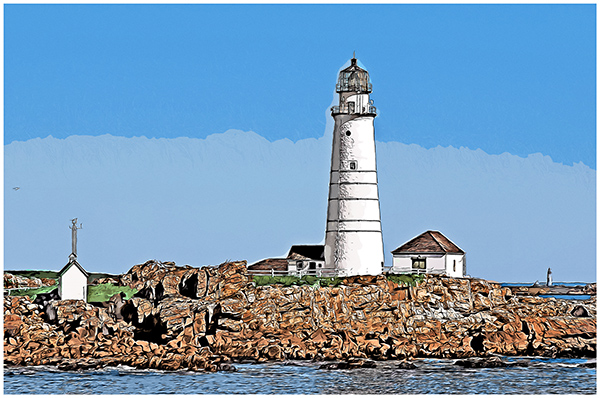
Illustrative digital painting of Boston Harbor Light in Massachusetts.
During the War of 1812, on a summer day in 1813, lighthouse keeper Jonathan Bruce and his wife Mary watched from their station on Little Brewster Island, the battle between the American Navy’s U.S.S. Chesapeake and the English warship HMS Shannon. This is battle is where Captain Lawrence of the Chesapeake was known to have made his famous cry “Don’t give up the ship!” His ship was rendered helpless and was boarded by British troops. The Chesapeake lost the battle and Captain Lawrence was killed in the fight.
In the 1840s, a keeper named Tobias Cook employed young women to manufacture what he called “Spanish Cigars” on Brewster Island near the lighthouse. It was a deceitful attempt to fool Boston smokers into believing the cigars were imported. These young women toiled for Cook under miserable conditions, with little pay. He was removed from duty when he was later discovered.
The tower still houses a Fresnel Lens from 1859 for visitors to view up close. It is an eleven-foot crystal made up of 336 individual prisms. This rotating lens projects the lighthouse’s 12 beams, which can be seen from 27 miles away. The climb to the 89-foot tower involves ascending 76 spiral stairs, followed by two ladders leading to the lantern room, where visitors can see the lens and enjoy a view of the harbor.
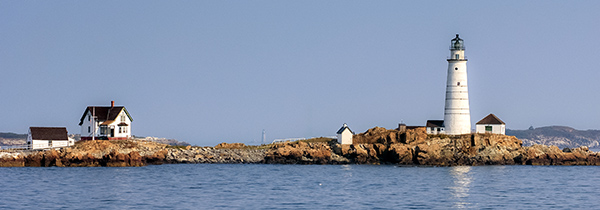
Boston Harbor Lighthouse on rocky Little Brewster Island in Massachusetts.
The 70th Keeper – Sally Snowman
Boston Harbor Lighthouse was the first to be constructed to operate with appointed keepers and the last lighthouse to be automated in 1998. The importance of the light keeper was officially recognized in 1989 when Congress passed a law stating that Boston Light would always be manned. With its over 300-year history, it had 69 male keepers tending to it. It remains the only lighthouse with a full-time keeper who tends the grounds and maintains the beacon year-round, Sally Snowman, the 70th keeper. Each summer season, she dressed in period costume for visitors during tours and helped celebrate the beacon’s 300-year anniversary in 2016. She climbed the tower at least twice daily and embodied the legacy of Boston Harbor Lighthouse and its predecessors. She also was directly involved in recruiting, training, and scheduling Boston Light’s 70 auxiliary volunteers. On December 31, 2023, after two decades of tending Boston Harbor Lighthouse (she was hired in 2003), Sally Snowman retired as the last lighthouse keeper in America. A sign outside the keeper’s house reads “We will leave the light on for you.”
While Boston Harbor Lighthouse was the first lighthouse station built in the country in 1716, the explosion detonated by the British in 1776 during the Revolutionary War altered the history of the lighthouse tower, as Boston Harbor Light does not currently house the oldest existing active lighthouse tower. The oldest original active lighthouse tower is at Sandy Hook Light in New Jersey, which was built in 1764. Since the original site and surrounding buildings of Boston Light have remained intact, Boston Harbor Lighthouse still claims to be the oldest active lighthouse “station” in the country. In 2026, it will be celebrating its 310th anniversary of operation.
Exploring Boston Harbor Light and Grounds
The lighthouse is located on Little Brewster Island, marking the entrance to Boston Harbor. Tours are offered to cruise past the island, and park tours are available to get on the island and explore the lighthouse during the summer months. The Boston Harbor Islands Park Service and Boston Harbor Now provide narrated trips by the park rangers during the summer where visitors can see Boston Harbor Lighthouse, Graves Lighthouse, and Long Island Head Lighthouse. They have been directly involved in preserving all 34 islands in the harbor. Boston Harbor Now is the non-profit partner of the Boston Harbor Islands National and State Park. They also offer public ferry services, as well as cultural and recreational activities.
Enjoy!
Allan Wood
Books to Explore
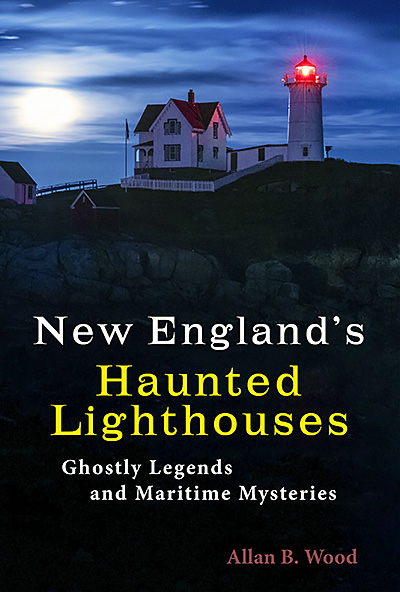
New England’s Haunted Lighthouses
New England’s Haunted Lighthouses:
Ghostly Legends and Maritime Mysteries
Uncover the mysteries of New England’s haunted lighthouses! Uncover ghostly tales of lingering keepers, victims of misfortune or local shipwrecks, lost souls, ghost ships, and more. Many of these accounts begin with actual historical events that later give rise to unexplained incidents. Immerse yourself in the tales associated with these iconic beacons!
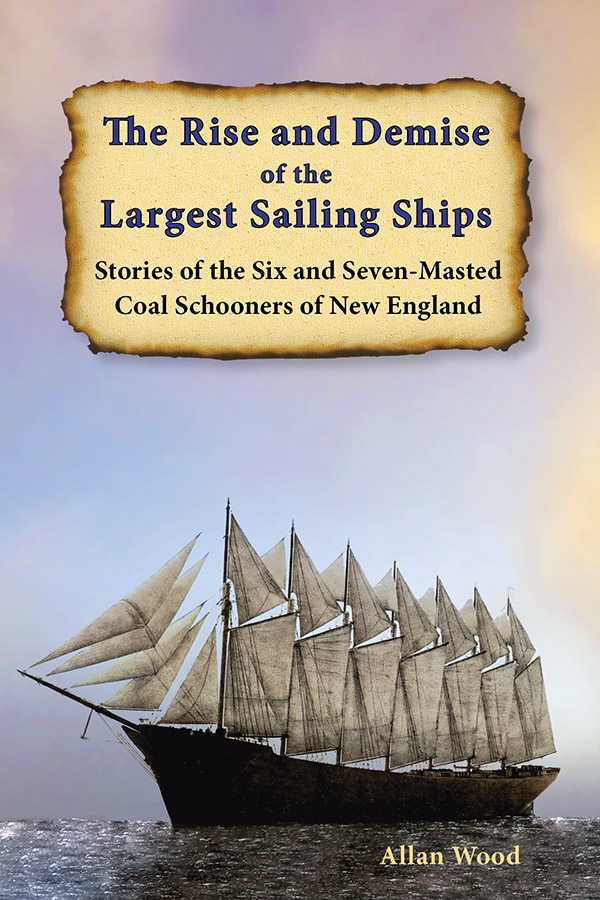
The Rise and Demise of the Largest Sailing Ships
The Rise and Demise of the Largest Sailing Ships:
Stories of the Six and Seven-Masted Coal Schooners of New England
In the early 1900s, New England shipbuilders constructed the world’s largest sailing ships amid social and political reforms. These giants were the ten original six-masted coal schooners and one colossal seven-masted vessel, built to carry massive quantities of coal and building supplies, and measured longer than a football field! This self-published book, rich in color and vintage images, showcases the historical accounts that accompanied these mighty ships.
Available also from bookstores in paperback, hardcover, and as an eBook for all devices.

Book – Lighthouses and Coastal Attractions in Southern New England: Connecticut, Rhode Island, Massachusetts
Lighthouses and Coastal Attractions of Southern New England:
Connecticut, Rhode Island, and Massachusetts.
This 300-page book provides memorable human interest stories from each of the 92 lighthouses, including those beacons in Boston Harbor. You can explore plenty of indoor and outdoor coastal attractions, including whale-watching excursions, lighthouse tours, windjammer sailing tours, parks, museums, and even lighthouses where you can stay overnight. You’ll also find plenty of stories of hauntings around lighthouses.

Book – Lighthouses and Coastal Attractions in Northern New England: New Hampshire, Maine, Vermont
Lighthouses and Coastal Attractions of Northern New England:
New Hampshire, Maine, and Vermont.
This 300-page book provides memorable human interest stories from each of the 76 lighthouses. It also describes and provides contact info for plenty of indoor and outdoor coastal attractions and tours. These include whale watching, lighthouse tours, unique parks, museums, and lighthouses where you can stay overnight. There are also stories of haunted lighthouses in these regions.
Copyright © Allan Wood Photography; do not reproduce without permission. All rights reserved.

Join, Learn, and Support The American Lighthouse Foundation